
Artificial intelligence (AI) is transforming the way people work, communicate, learn, and make decisions. From chatbots that answer customer questions to systems that analyze data and generate content, AI is becoming an important part of modern life.
Businesses use AI to automate repetitive tasks, understand customer behavior, improve productivity, and support decision-making. However, AI also creates challenges, including privacy concerns, misinformation, security risks, and potential changes in employment.
In this guide, we will explore what artificial intelligence is, how it works, its different types, its everyday uses, and its major benefits and dangers.
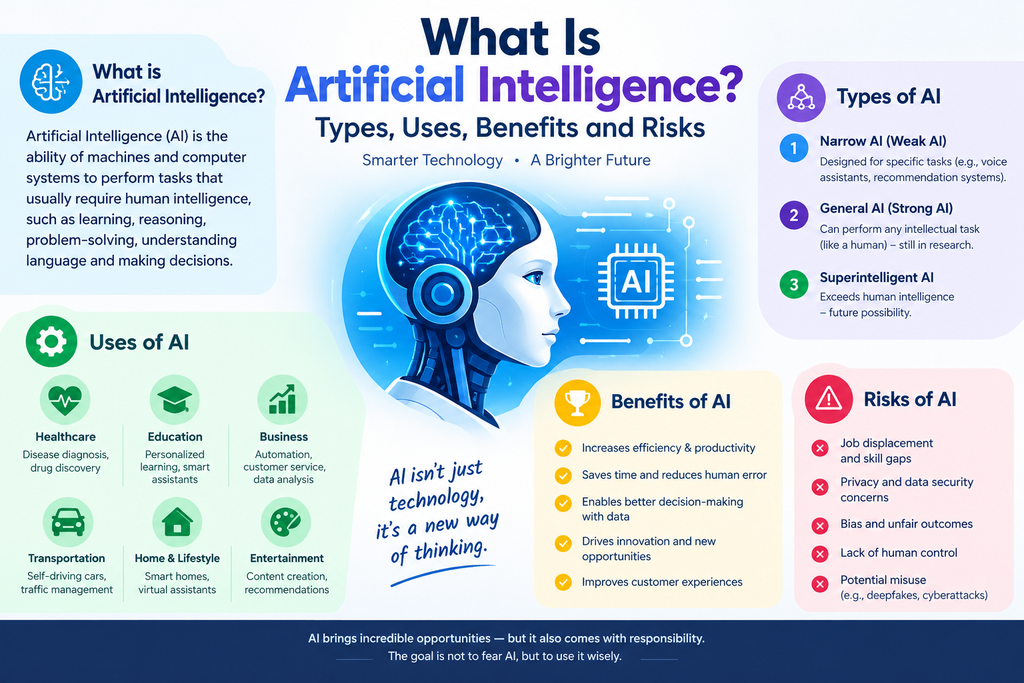
Key Takeaways
- Artificial intelligence enables computer systems to perform tasks that typically require human cognitive abilities, such as learning, recognizing patterns, understanding language, and solving problems.
- Machine learning, deep learning, and natural language processing are important AI-related technologies.
- AI is used in healthcare, finance, education, digital marketing, manufacturing, and customer service.
- Its benefits include increased efficiency, faster data analysis, automation, and improved decision support.
- Its risks include inaccurate outputs, bias, privacy violations, cybersecurity threats, and potential job displacement.
- AI is not error-free and works best when combined with human judgment, appropriate safeguards, and reliable data.
What Is Artificial Intelligence?
Artificial intelligence, commonly known as AI, is a field of computer science focused on developing systems that can perform tasks associated with human intelligence. These tasks may include learning from data, identifying patterns, understanding language, generating content, making predictions, and supporting decisions.
AI systems use different techniques, algorithms, and models to process information and produce outputs. Some systems follow predefined rules, while others learn patterns from data to perform specific tasks.
For example, an AI chatbot can answer questions, an image recognition system can identify objects in photographs, and a recommendation system can suggest products based on customer preferences.
AI does not necessarily think, feel, or understand the world in the same way humans do. Its capabilities depend on how the system is designed, the data available to it, and the task it is intended to perform.
According to IBM’s introduction to artificial intelligence, AI encompasses technologies that simulate aspects of human learning, problem-solving, decision-making, and creativity.
How Does Artificial Intelligence Work?
Artificial intelligence works through a combination of data, algorithms, models, and computing power. The exact process depends on the type of AI system.
A simplified AI workflow includes the following steps:
- Data collection: The system receives relevant information, such as text, images, numbers, or customer activity.
- Data processing: The information is prepared and organized so the system can use it.
- Model training or configuration: Depending on the system, algorithms learn patterns from data or apply predefined rules.
- Analysis and prediction: The system processes new inputs and generates a prediction, classification, recommendation, or response.
- Evaluation and improvement: Developers and users assess performance and make improvements where needed.
For example, an ecommerce recommendation system can analyze previous purchases and browsing activity to suggest products that a customer may find relevant.
However, AI results are not always accurate. The quality of the output depends on factors such as data quality, model limitations, system design, and the context in which it is used.
What Are the Different Types of Artificial Intelligence?
AI can be classified according to its capabilities or the technologies used to build it. One common classification describes three capability levels.
1. Artificial Narrow Intelligence (ANI)
Artificial Narrow Intelligence, also called narrow AI, is designed to perform a specific task or a limited set of related tasks.
Most AI applications used today fall into this category. They can perform useful tasks without possessing general human intelligence.
Examples include:
- Virtual assistants that respond to voice commands.
- Recommendation systems that suggest products or videos.
- AI chatbots that answer customer questions.
- Fraud detection systems that identify suspicious transactions.
- AI writing tools that generate and edit content.
Narrow AI can perform certain tasks very effectively, but its capabilities remain limited by the system’s design and training.
2. Artificial General Intelligence (AGI)
Artificial General Intelligence refers to a hypothetical form of AI that could learn, understand, and perform a broad range of intellectual tasks at a human-like level across different situations.
Unlike narrow AI, AGI would be able to transfer knowledge and skills across a much wider range of tasks.
Current status: AGI, as defined by this broad capability, has not been established as an achieved technology. It remains a research goal and a subject of debate.
3. Artificial Superintelligence (ASI)
Artificial Superintelligence describes a hypothetical AI system that would exceed human intellectual capabilities across a wide range of domains.
This concept is often discussed in relation to the possible future of AI, including its implications for society, safety, and governance.
Current status: ASI is theoretical and is not an existing, demonstrated category of AI technology.
For further reading, see IBM’s guide to AI types.
AI, Machine Learning, Deep Learning, and Generative AI: What Is the Difference?
These terms are related, but they do not mean the same thing.
- Artificial intelligence (AI): The broad field of creating systems that perform tasks associated with intelligence.
- Machine learning (ML): A subset of AI in which systems learn patterns from data to make predictions or decisions.
- Deep learning: A subset of machine learning that uses neural networks with multiple layers to learn complex patterns.
- Generative AI: AI that creates new content, such as text, images, audio, video, or code.
For example, a generative AI tool may use deep learning to create an article from a written prompt.
Learn more in IBM’s comparison of AI, machine learning, and deep learning.
What Are the Uses of Artificial Intelligence?
AI is used across many industries to improve workflows, analyze information, and support human decision-making.
1. Artificial Intelligence in Digital Marketing
AI helps digital marketers research keywords, generate content ideas, analyze campaign data, segment audiences, and automate marketing workflows.
For example, marketers can use AI-assisted tools to draft social media captions, identify SEO opportunities, personalize email campaigns, and analyze advertising performance.
AI can save time, but marketers should review the output for accuracy, originality, brand consistency, and relevance to the target audience.
2. Artificial Intelligence in Healthcare
Healthcare professionals can use AI tools to support medical image analysis, identify patterns in clinical data, assist research, and manage administrative tasks.
For example, certain AI systems can help clinicians examine medical images for potential abnormalities.
AI should not replace qualified medical professionals. Clinical decisions require appropriate validation, professional judgment, and consideration of individual patient circumstances.
3. Artificial Intelligence in Finance
Financial institutions use AI to identify suspicious transactions, assess certain types of risk, analyze financial data, and automate customer support.
For example, a bank may use machine learning to flag unusual account activity for further investigation.
AI can support fraud detection, but it may also generate false alarms or fail to identify some fraudulent activity.
4. Artificial Intelligence in Education
AI-powered educational tools can explain concepts, generate practice questions, assist language learning, and provide personalized learning resources.
Students can use AI to understand difficult topics, while teachers can use it to prepare lesson materials and support administrative work.
However, students should verify information and follow their institution’s academic integrity rules.
5. Artificial Intelligence in Manufacturing
Manufacturers use AI to inspect products, identify equipment problems, forecast maintenance needs, and optimize production processes.
For example, an AI-powered quality inspection system can analyze product images to flag possible manufacturing defects.
These applications can improve efficiency, although performance depends on reliable data, suitable equipment, and proper testing.
6. Artificial Intelligence in Customer Service
Businesses use AI chatbots and virtual assistants to answer common questions, provide basic support, and direct customers to the appropriate department.
For example, an online store may use a chatbot to answer questions about delivery, return policies, and order tracking.
More complex complaints and sensitive customer issues may still require human support.
What Are the Benefits of Artificial Intelligence?
AI can provide several benefits when it is used appropriately and monitored effectively.
1. Increased Efficiency and Productivity
AI can automate repetitive tasks and help employees complete certain activities more quickly.
For example, a marketing team can use AI to draft content, summarize reports, and organize campaign information, leaving more time for strategy and creative work.
2. Faster Data Analysis
AI systems can process large datasets and identify patterns that may be difficult to detect manually.
Businesses can use these insights to understand customer behavior, monitor performance, and investigate potential opportunities.
3. Reduced Operational Costs
Automation can reduce the time and resources required for some repetitive processes.
However, the overall cost savings depend on software expenses, implementation, maintenance, staff training, and the complexity of the workflow.
4. Improved Personalization
AI can help businesses tailor recommendations, advertisements, and messages to different customer groups.
When based on relevant and appropriately handled data, personalization can make customer interactions more useful.
5. Support for Decision-Making
AI can help people compare information, identify trends, and evaluate possible outcomes.
It should be used as a decision-support tool rather than an unquestioned authority, especially in high-impact areas such as healthcare, finance, and employment.
6. Assistance With Accessibility
AI-powered speech recognition, text-to-speech, automatic captions, and translation tools can help people access information and communicate more easily.
These tools can improve accessibility, although the quality of their results varies across languages, contexts, and individual needs.
What Are the Dangers and Risks of Artificial Intelligence?
Despite its benefits, AI creates important challenges that individuals and organizations need to understand.
1. Job Displacement and Changing Employment
AI can automate some tasks that people currently perform, potentially reducing demand for certain roles or changing the skills required for existing jobs.
However, the effects vary by industry and occupation. AI can also create new responsibilities and help employees perform their work more effectively.
Workers and businesses can prepare by developing digital skills, learning to use AI responsibly, and focusing on tasks that require human judgment, communication, and specialized expertise.
2. Privacy and Data Protection Risks
AI systems may process personal, financial, business, or other sensitive information.
If this information is collected, stored, or shared improperly, it can create privacy and security problems.
Organizations should use appropriate access controls, minimize unnecessary data collection, and follow applicable data protection requirements.
3. Cybersecurity Threats
AI can be misused to create convincing phishing messages, automate certain malicious activities, and support more sophisticated scams.
AI systems can also introduce security vulnerabilities if they are poorly designed or improperly integrated.
Businesses should maintain security controls, verify suspicious requests, protect sensitive information, and regularly review their systems.
4. Misinformation and Inaccurate Outputs
Generative AI can produce incorrect information, fabricated references, misleading images, or convincing but false claims.
This can be harmful when people share AI-generated content without checking its accuracy.
Always verify important information against trustworthy sources, particularly when publishing factual articles or making consequential decisions.
5. Bias and Unfair Decisions
AI systems can reproduce or amplify biases present in their training data or design.
For example, an AI-assisted recruitment system could unfairly disadvantage certain candidates if it relies on biased historical hiring data.
Testing, representative data, transparency, and human oversight can help identify and reduce these risks.
6. Overdependence on AI
Relying too heavily on AI can weaken independent evaluation and allow mistakes to pass unnoticed.
People may also accept AI recommendations without understanding their limitations.
A better approach is to use AI as an assistant while maintaining human responsibility for important decisions.
How Can We Use Artificial Intelligence Safely?
Individuals and businesses can reduce AI-related risks by following practical safeguards:
- Verify important AI-generated information before using or publishing it.
- Avoid entering confidential or sensitive information into tools that are not approved for that purpose.
- Review AI-generated content for bias, misleading claims, and errors.
- Use appropriate human oversight for important decisions.
- Keep software updated and follow cybersecurity best practices.
- Understand the privacy policies and data-handling practices of the AI tools you use.
- Monitor AI systems regularly and correct problems when they appear.
Responsible AI use combines technological capability with human judgment, accountability, and appropriate safeguards.
Conclusion
Artificial intelligence is an important technology that is changing how people work, learn, communicate, and solve problems. It can improve productivity, analyze data, support decision-making, and automate repetitive tasks across industries.
At the same time, AI is not perfect. Its limitations include inaccurate outputs, privacy risks, bias, security threats, and potential changes in employment.
The best approach is to understand how AI works, choose appropriate tools, verify important outputs, and use the technology responsibly.
As AI continues to develop, people and businesses that combine AI capabilities with human expertise and critical thinking will be better positioned to make informed decisions.
Frequently Asked Questions (FAQs)
What is artificial intelligence in simple words?
Artificial intelligence is technology that enables computers to perform tasks such as recognizing patterns, understanding language, generating content, and making predictions.
What are the main types of AI?
A common capability-based classification includes Artificial Narrow Intelligence (ANI), Artificial General Intelligence (AGI), and Artificial Superintelligence (ASI). Narrow AI is widely used today, while AGI and ASI remain hypothetical.
What are five uses of artificial intelligence?
Five common uses include digital marketing, healthcare, finance, education, and manufacturing.
What are the main benefits of AI?
AI can improve productivity, speed up data analysis, automate repetitive tasks, support personalization, and assist decision-making.
What are the biggest risks of AI?
Major risks include privacy violations, misinformation, bias, cybersecurity threats, overdependence on automated systems, and potential job displacement.
Can artificial intelligence replace humans?
AI can automate certain tasks, but it does not replace every human capability. Many activities still require human judgment, accountability, creativity, empathy, and specialized expertise.
Is artificial intelligence always accurate?
No. AI can produce incorrect, incomplete, or biased results. Important outputs should be checked against reliable sources and reviewed by qualified people where necessary.
About the Author – Devansh Mehrotra
Devansh Mehrotra is a digital marketing professional and the author at Devansh Digital. He specializes in digital marketing, with practical experience in SEO, Google Ads, Meta Ads, lead generation, and performance marketing.
Through Devansh Digital, he shares actionable insights, practical guides, and the latest trends in digital marketing, artificial intelligence (AI), search engine optimization, paid advertising, content marketing, and marketing automation.
His goal is to help businesses, entrepreneurs, and aspiring marketers understand digital marketing strategies, discover useful tools, generate quality leads, and improve their online presence.
Devansh is passionate about exploring new marketing technologies and simplifying complex marketing concepts into easy-to-understand, practical information that readers can apply to their own projects and businesses.
Areas of Expertise: SEO, Google Ads, Meta Ads, Lead Generation, Performance Marketing, AI Marketing Tools, Content Marketing, and Digital Marketing Strategy.