
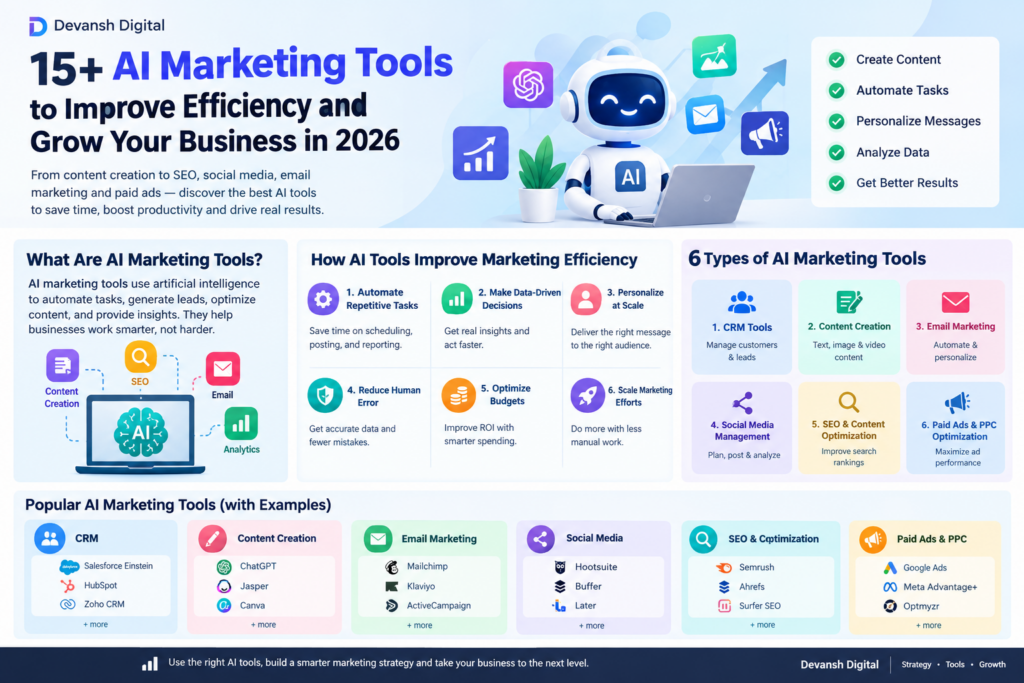
AI marketing tools help marketers save time by creating content, analyzing customer data, personalizing campaigns, and automating repetitive tasks. With the right tools, businesses can streamline their marketing activities, improve decision-making, and manage campaigns more efficiently.
From AI-powered content creation to SEO optimization and email automation, these tools are changing how marketing teams plan and execute their strategies.
Key Takeaways
- AI marketing tools help businesses create content, automate repetitive tasks, personalize customer experiences, and analyze marketing data.
- Businesses can use AI to improve productivity, streamline workflows, and make more informed marketing decisions.
- AI marketing tools support different marketing channels, including SEO, social media, email marketing, CRM, and paid advertising.
- Choosing the right AI marketing tools depends on your business goals, budget, marketing channels, and existing workflow.
- AI can improve efficiency, but human oversight remains essential for accuracy, creativity, and brand consistency.
What Are AI Marketing Tools?
AI marketing tools are software applications that use artificial intelligence to support or automate marketing activities. They help businesses perform tasks such as content creation, keyword research, customer segmentation, campaign analysis, email personalization, and advertising optimization.
Traditional marketing workflows often require significant time and manual effort. AI-powered tools can simplify many of these processes, allowing marketers to focus more on strategy, creativity, and business growth.
For example, marketers can use AI to generate content ideas, analyze website performance, identify potential customers, draft email campaigns, and discover opportunities to improve advertising performance.
However, AI marketing tools do not automatically guarantee more leads, higher rankings, or better returns on investment (ROI). Their effectiveness depends on the quality of the data, the chosen strategy, and how well marketers implement their recommendations.
How Do AI Tools Improve Marketing Efficiency?
AI marketing tools can improve productivity by reducing repetitive work, helping marketers analyze information, and supporting faster decision-making. Here are six important ways they can improve marketing efficiency.
1. Automate Repetitive Tasks
Marketing teams regularly perform tasks such as scheduling social media posts, preparing email campaigns, organizing customer information, and generating performance reports.
AI-powered tools can automate or simplify many of these activities, reducing the amount of time spent on routine work.
For example, a social media manager can use AI to generate post ideas, prepare captions, and organize a weekly content calendar. An email marketer can automate campaign workflows and customer follow-ups.
This allows marketing professionals to dedicate more time to campaign strategy, creative development, and business objectives.
2. Make Data-Driven Decisions
AI marketing tools can analyze campaign performance, customer behavior, website traffic, and engagement metrics to identify useful patterns.
These insights can help marketers understand which campaigns are performing well, which audiences are responding, and where improvements may be needed.
For example, an advertising team can analyze conversion data to identify underperforming campaigns and investigate opportunities to improve cost per lead.
AI recommendations should still be reviewed against reliable data and business objectives before major decisions are made.
3. Personalize Marketing at Scale
Personalization helps businesses deliver more relevant messages, offers, and recommendations to different customer groups.
AI tools can use available customer data, browsing behavior, purchase history, and engagement patterns to support audience segmentation and personalized communication.
For example, an ecommerce business can recommend products based on previous purchases or send different email campaigns to new customers and returning buyers.
Personalization can improve the customer experience when businesses use appropriate data, respect privacy requirements, and avoid irrelevant messaging.
4. Reduce Human Error
Manual marketing processes can lead to mistakes, such as incorrect data entry, inconsistent reporting, broken links, and errors in campaign setup.
Automation and AI-assisted workflows can help reduce some of these errors by standardizing processes and identifying potential problems.
For example, an email marketing platform may help marketers validate contact fields, identify missing information, and test campaigns before sending them.
However, AI systems can also make mistakes. Human review, quality checks, and accurate source data remain important for maintaining reliable marketing operations.
5. Optimize Marketing Budgets
AI-powered analytics and advertising features can help marketers evaluate campaign performance and identify opportunities to allocate budgets more effectively.
For example, automated bidding in Google Ads can use available auction-time signals to adjust bids according to a campaign’s conversion goals.
Similarly, advertising analytics can help marketers compare audience segments, creative variations, and conversion costs.
AI does not guarantee a positive ROI. Marketers should monitor spending, conversion quality, campaign objectives, and profitability before increasing budgets.
6. Scale Marketing Efforts
AI tools can help businesses manage more marketing activities without increasing manual workload at the same rate.
Small businesses and freelancers can use AI to support content production, SEO research, email campaigns, and reporting. Larger teams can integrate AI into existing workflows to improve coordination and efficiency.
For example, one marketer may use several connected tools to plan content, schedule social media posts, track campaign performance, and prepare reports.
The goal is not simply to replace human effort. It is to combine automation with human expertise to support sustainable business growth.
6 Types of AI Marketing Tools for Digital Marketing
Different AI marketing tools serve different purposes. Understanding these categories can help you choose tools that match your marketing requirements.
1. AI-Powered Customer Relationship Management (CRM) Tools
AI-powered CRM tools help businesses organize customer information, manage sales pipelines, automate follow-ups, and identify potential sales opportunities.
They can support lead scoring, customer segmentation, sales forecasting, and personalized customer communication.
Examples of AI-powered CRM tools include:
- Salesforce Einstein
- HubSpot CRM and its AI features
- Zoho CRM and Zia
- Microsoft Dynamics 365
- Pipedrive
- Freshsales
These tools can help sales and marketing teams coordinate their activities, understand customer needs, and manage leads more effectively.
2. AI Content Creation Tools
AI content creation tools help marketers generate content ideas, draft articles, create social media captions, develop marketing copy, and produce visual or video content.
They can support content production while helping teams maintain a consistent publishing workflow.
Examples of AI content creation tools include:
- Written content: ChatGPT, Claude, Jasper, Copy.ai, and Writesonic
- Visual content: Canva, Midjourney, and DALL·E
- Video content: Synthesia, Descript, Pictory, Runway, and OpusClip
These tools can accelerate content production, but marketers should review the output for factual accuracy, originality, brand voice, and audience relevance before publishing.
3. AI Email Marketing and Automation Tools
AI-powered email marketing tools help businesses create email copy, organize subscriber segments, automate customer journeys, and analyze campaign performance.
Some platforms also provide features for send-time optimization, predictive segmentation, and personalized product recommendations.
Examples of AI email marketing tools include:
- Mailchimp
- Klaviyo
- HubSpot Marketing Hub
- ActiveCampaign
- Brevo
- Mailmodo
- Omnisend
For example, an ecommerce business can use automated email sequences to welcome new subscribers, follow up on abandoned carts, and recommend relevant products to existing customers.
These workflows can improve marketing efficiency when they are supported by relevant messaging, accurate customer data, and regular performance analysis.
4. AI Social Media Management Tools
AI-powered social media management tools help marketers plan content, generate captions, schedule posts, analyze engagement, and manage multiple social platforms.
They can also help identify content opportunities and provide insights into audience behavior.
Examples of social media management tools include:
- Hootsuite
- Sprout Social
- Buffer
- Later
- Predis.ai
- Metricool
- Brandwatch
Some platforms focus on scheduling and analytics, while others emphasize AI content generation, social listening, or brand monitoring.
These tools can help businesses maintain a consistent publishing schedule and use performance data to improve their social media strategy.
5. AI SEO and Content Optimization Tools
AI-powered SEO tools help marketers research keywords, analyze competitors, optimize content, identify technical issues, and discover opportunities to improve organic search visibility.
Depending on the platform, they may offer content briefs, topic research, keyword clustering, on-page recommendations, and website audits.
Examples of SEO and content optimization tools include:
- Semrush
- Ahrefs
- Surfer SEO
- Clearscope
- Frase
- MarketMuse
- Moz Pro
For example, an SEO specialist can use these tools to identify relevant search terms, analyze competing pages, and improve the structure and usefulness of website content.
However, using AI does not automatically improve Google rankings. Content quality, search intent, technical SEO, website authority, and user experience remain important considerations.
6. AI Paid Advertising and PPC Optimization Tools
AI-powered advertising tools help marketers automate bidding, analyze conversion data, test creative variations, and improve campaign management.
They can also support budget allocation, audience targeting, and performance reporting across advertising platforms.
Examples of AI-powered advertising tools and platforms include:
- Google Ads, including Smart Bidding and Performance Max
- Meta Advantage+ advertising features
- Optmyzr
- Smartly
- Revealbot
- Madgicx
These platforms offer different capabilities, ranging from built-in advertising automation to third-party campaign management and optimization.
For example, a performance marketer can use Google Ads conversion data to support automated bidding strategies or use campaign reporting to identify opportunities to improve cost per acquisition.
AI-powered advertising can support better optimization, but results depend on campaign setup, conversion tracking, creative quality, audience demand, and the accuracy of the underlying data.
How to Choose the Right AI Marketing Tools
Before investing in AI marketing software, consider the following factors:
- Define your marketing goals: Decide whether you want to improve SEO, generate leads, automate emails, create content, or optimize paid campaigns.
- Evaluate your budget: Compare free plans, paid subscriptions, usage limits, and additional costs.
- Check integrations: Choose tools that work with your existing website, CRM, analytics platform, and marketing channels.
- Prioritize ease of use: Select tools that fit your team’s skills and workflow.
- Review data privacy: Understand how customer data is collected, processed, and stored.
- Measure performance: Track relevant metrics such as time saved, conversion rate, cost per lead, organic traffic, and campaign ROI.
Start with one or two tools that address your biggest challenges. Measure their impact before adding more software to your marketing stack.
Conclusion
AI marketing tools are changing how businesses plan, create, analyze, and optimize their marketing activities. From CRM and content creation to SEO, email automation, social media management, and paid advertising, these tools can help marketers work more efficiently and make better use of available data.
However, successful marketing still requires strategic thinking, creativity, customer understanding, and human oversight. AI should support these capabilities rather than replace the need for sound marketing decisions.
The best approach is to choose AI tools that match your business goals, integrate them into your existing workflow, and measure their actual impact on productivity and performance.
Ready to improve your digital marketing strategy? Explore the right combination of AI tools, SEO practices, and performance marketing techniques to build a more efficient and scalable marketing workflow.
About the Author – Devansh Mehrotra

Devansh Mehrotra is a digital marketing professional and the author at Devansh Digital. He specializes in digital marketing, with practical experience in SEO, Google Ads, Meta Ads, lead generation, and performance marketing.
Through Devansh Digital, he shares actionable insights, practical guides, and the latest trends in digital marketing, artificial intelligence (AI), search engine optimization, paid advertising, content marketing, and marketing automation.
His goal is to help businesses, entrepreneurs, and aspiring marketers understand digital marketing strategies, discover useful tools, generate quality leads, and improve their online presence.
Devansh is passionate about exploring new marketing technologies and simplifying complex marketing concepts into easy-to-understand, practical information that readers can apply to their own projects and businesses.
Areas of Expertise: SEO, Google Ads, Meta Ads, Lead Generation, Performance Marketing, AI Marketing Tools, Content Marketing, and Digital Marketing Strategy.